
Pointillism offers a captivating avenue for art education, broadening artistic horizons and fostering appreciation for detail and color theory within the classroom setting.
This unique method challenges students to critically examine color mixing and composition, serving as a valuable tool for teaching fundamental art principles and sparking creativity.
Introducing pointillism through interactive lessons, renowned artworks, and collaborative projects inspires a deeper understanding and engagement with this distinctive artistic technique.
By exploring its origins and techniques, educators can empower students to develop their artistic skills and appreciate the nuances of optical blending and perception.
What is Pointillism?
Pointillism, a post-impressionist technique, is a systematic painting method where small, distinct dots of pure color are applied in patterns to a surface. These dots aren’t blended on the canvas; instead, the viewer’s eye and mind optically mix them, creating a vibrant and luminous effect. It’s a fascinating exploration of color theory and perception!
Unlike traditional painting where colors are physically mixed, pointillism relies on the principle of “optical mixing.” This means that when colors are placed close together, the human eye perceives a blended hue, resulting in a richer and more dynamic visual experience. This technique demands precision and patience, encouraging students to carefully consider color relationships.
Essentially, pointillism isn’t about applying paint; it’s about applying color theory in a visually striking way. It’s a method that challenges conventional painting techniques and invites students to think differently about how colors interact and create form. It’s a beautiful demonstration of how perception plays a crucial role in our understanding of art.

This approach allows for a unique exploration of light and shadow, and the overall effect is often a shimmering, almost mosaic-like quality.
Historical Context of Pointillism
Pointillism emerged in the late 19th century, specifically between 1886 and 1895, as a reaction against Impressionism. While Impressionists captured fleeting moments and the effects of light, Pointillists sought a more scientific and calculated approach to color and perception. It arose from the theories of scientists like Michel Eugène Chevreul, who studied simultaneous contrast and optical mixing.
This movement was spearheaded by Georges Seurat and Paul Signac, who believed that color could be broken down into its constituent parts and then reassembled on the canvas to create a more intense and harmonious visual experience. They aimed to create a more “stable” and “ordered” form of Impressionism, moving away from its perceived spontaneity.
Pointillism was a short-lived but influential style, representing a fascinating intersection of art, science, and theory. It challenged traditional artistic conventions and paved the way for further experimentation in abstract art. Understanding this historical context is crucial for appreciating the intellectual and artistic motivations behind this unique technique.
It represents a pivotal moment in the development of modern art, bridging the gap between Impressionism and Fauvism.
Georges Seurat: The Founder of Pointillism
Georges Seurat (1859-1891) is widely recognized as the originator of Pointillism, a technique he meticulously developed and refined. Initially trained in traditional academic painting, Seurat became fascinated with scientific color theory and the optical effects of juxtaposed hues. His groundbreaking work, A Sunday on La Grande Jatte (1884-1886), exemplifies his innovative approach.
Seurat wasn’t simply applying dots randomly; each dot was carefully considered in relation to its neighboring colors, aiming to achieve optical mixing in the viewer’s eye. He believed this method would create a greater sense of luminosity and vibrancy than traditional blending techniques.
His dedication to this scientific approach was unwavering, and he meticulously documented his process. Seurat’s influence extends beyond Pointillism, impacting subsequent art movements and inspiring artists to explore new ways of representing light, color, and perception. Presenting his work allows students to understand the origins of this technique.
He remains a central figure in the history of modern art.
Paul Signac: A Key Figure in Pointillism
Paul Signac (1863-1935) was instrumental in the development and propagation of Pointillism, becoming a leading proponent alongside Georges Seurat. Initially an Impressionist, Signac was captivated by Seurat’s scientific approach to color and quickly adopted the Pointillist technique, becoming a dedicated follower and advocate.
Unlike Seurat’s more deliberate and calculated approach, Signac’s Pointillism often exhibited a greater sense of spontaneity and expressive brushwork, utilizing larger, more vibrant dots. He actively promoted the technique through writings and exhibitions, helping to establish it as a recognized art movement.
Signac’s landscapes and harbor scenes, characterized by their brilliant colors and dynamic compositions, demonstrate the versatility of Pointillism. He also explored Divisionism, a related theory emphasizing the separation of colors. Introducing Signac alongside Seurat provides a broader understanding of the movement’s evolution and diverse interpretations.
His work showcases the technique’s adaptability.
Preparing for a Pointillism Lesson
Effective lesson preparation involves gathering necessary materials, adapting activities for various age groups, and integrating color theory concepts for a successful classroom experience.
Careful planning ensures students grasp Pointillism’s principles and appreciate its connection to Impressionism, fostering creativity and artistic understanding.
Materials Needed for Pointillism Painting
Successful Pointillism lessons require specific materials to facilitate the dot application technique and color mixing exploration. Essential supplies include high-quality acrylic paints, offering vibrant colors and good coverage for distinct dot creation. Alternatively, watercolor paints can be used, though achieving the same intensity may require layering.
Crucially, a variety of small, round paintbrushes are needed – sizes 0, 2, and 4 are ideal for creating dots of differing sizes. Cotton swabs or the rounded ends of pencils can also serve as effective dotting tools, especially for younger students developing fine motor skills.
Prepare sturdy watercolor paper or canvas boards to withstand the layering of paint without buckling. Palettes, either disposable or reusable, are necessary for mixing and organizing colors. Water containers for brush cleaning and paper towels for blotting are also fundamental.
Consider providing students with palettes featuring a limited color range initially, encouraging them to experiment with mixing to achieve desired hues. Finally, protective coverings for desks and aprons for students will minimize mess and ensure a more enjoyable painting experience.
Age-Appropriate Adaptations for Pointillism
Adapting Pointillism for different age groups is crucial for successful classroom implementation. For younger students (ages 6-8), simplify the process by focusing on color exploration rather than strict adherence to optical mixing. Larger paper formats and fewer colors can reduce frustration.
Utilize pre-drawn outlines or simple shapes to provide structure and allow them to concentrate on dot application. Cotton swabs are excellent dotting tools for developing fine motor skills. With middle school students (ages 9-13), introduce basic color theory concepts and encourage more deliberate color choices.
Challenge them to mix colors using dots to create secondary and tertiary hues. Canvas boards offer a more professional surface. For high school students (ages 14+), explore advanced techniques like complementary color interactions and complex compositions.
Encourage experimentation with different dot sizes and densities to achieve varying tonal values. Discuss the historical context and artistic intent behind Pointillism, fostering critical thinking and artistic expression.
Integrating Pointillism with Color Theory
Pointillism provides a uniquely effective platform for teaching color theory concepts. Unlike traditional mixing on a palette, Pointillism demonstrates optical mixing – the brain perceives blended colors from juxtaposed dots. Begin by reviewing primary colors and their combinations to create secondary hues.
Demonstrate how placing dots of complementary colors (e.g., red and green) near each other intensifies their vibrancy. Explore analogous color schemes by arranging dots of colors adjacent on the color wheel, creating harmonious effects.
Discuss the impact of dot density on perceived value; closer dots create darker tones, while sparser dots appear lighter. Encourage students to experiment with varying dot sizes and spacing to control tonal variations.
Challenge them to recreate grayscale values using only dots of primary colors, reinforcing their understanding of additive color mixing. This hands-on approach solidifies color theory principles in a visually engaging way.
Connecting Pointillism to Other Art Movements (Impressionism)
Pointillism emerged as a direct response to, and evolution from, Impressionism; Begin by reviewing the core tenets of Impressionism – capturing fleeting moments, emphasizing light and color, and using visible brushstrokes.
Explain how Pointillists, like Seurat and Signac, sought to apply scientific principles to painting, believing a more ‘objective’ representation of light was achievable through systematic dot application.
Contrast the loose, expressive brushwork of Impressionists like Monet with the meticulous, dot-based technique of Pointillism. Discuss how both movements shared a focus on light and color, but differed in their approach.
Show examples of Impressionist paintings alongside Pointillist works, prompting students to identify similarities and differences in technique and aesthetic effect. Highlight how Pointillism refined and radicalized Impressionist ideals.
Emphasize that Pointillism, while short-lived, represents a fascinating intersection of art, science, and the pursuit of optical truth within the broader context of late 19th-century art.

Step-by-Step Instruction in the Classroom
Teachers should demonstrate techniques, guide students through dot application exercises, and encourage color theory exploration, fostering engagement and creativity in a structured learning environment.
Demonstrating Pointillism Techniques
Begin by showcasing examples of Georges Seurat’s work, like “A Sunday on La Grande Jatte,” to visually introduce the core concept of applying distinct dots of pure color.
Explain that pointillism relies on optical mixing – the viewer’s eye blends the colors when seen from a distance, creating a luminous effect, rather than physically mixing paints on a palette.
Model the technique meticulously, using various brush sizes to demonstrate how dot size impacts visual texture and density. Show how closely spaced dots create darker values, while more sparse dots yield lighter tones.
Emphasize the importance of consistent dot size and spacing for a harmonious effect, but also encourage experimentation with variations to achieve different textures and moods.
Demonstrate layering colors – applying dots of different hues on top of each other to create complex shades and vibrant interactions. This illustrates how complementary colors enhance each other when placed in close proximity.
Highlight that patience is key, as building up an image with dots is a time-consuming process, but the resulting optical blend is worth the effort. Encourage students to embrace the meditative aspect of the technique.
Finally, walk around the classroom offering individual guidance and feedback as students begin their own dot application exercises.
Dot Application Exercises
Start with simple exercises focusing solely on dot control and consistency. Have students practice creating gradients using only one color, varying dot density to achieve lighter and darker values.
Next, introduce color mixing exercises. Provide a limited palette – primary colors plus white – and challenge students to create secondary colors solely through dot application, observing the optical blending effect.
Assign a “value scale” exercise, where students create a range of tones from white to black using only dots of varying sizes and spacing, reinforcing the relationship between dot density and perceived value.
Introduce a shape-based exercise. Students fill pre-drawn geometric shapes (circles, squares, triangles) with dots, experimenting with different color combinations and dot patterns within each shape.
Encourage students to create textured effects by varying dot size and direction. Demonstrate how small, tightly packed dots create a smooth surface, while larger, scattered dots create a rougher texture.
Provide constructive feedback, emphasizing the importance of precision and patience. Remind them that the magic of pointillism lies in the cumulative effect of countless individual dots.
Conclude by having students share their exercises and discuss their observations about optical mixing and color interaction.
Color Mixing with Dots: A Practical Guide
Explain that in pointillism, colors aren’t physically mixed on a palette; instead, the viewer’s eye blends them optically. Demonstrate this by applying small dots of complementary colors (red & green, blue & orange, yellow & violet) close together.
Begin with primary color combinations. Show how juxtaposing red and yellow dots creates the illusion of orange, and encourage students to experiment with varying dot ratios to alter the resulting hue.
Emphasize the importance of dot size and spacing. Smaller, closely spaced dots create a more intense color blend, while larger, more dispersed dots result in a softer, more subtle effect.
Introduce the concept of simultaneous contrast. Explain how a color appears different depending on the colors surrounding it, and how this principle is utilized in pointillist paintings.
Guide students through creating a color wheel using only dots. This exercise reinforces their understanding of color relationships and optical mixing principles.
Encourage experimentation with tertiary colors, achieved by combining primary and secondary dots. Observe how the eye perceives these blended hues.
Remind students that patience is key; the blending effect is subtle and requires careful application of numerous dots.
Building Composition with Pointillism
Discuss how pointillism isn’t just about color; it’s about constructing an entire image with dots. Begin by sketching a simple composition – a landscape, still life, or geometric design – before applying any paint.
Explain how varying dot density can create values and suggest form. Denser areas of dots appear darker, while sparser areas appear lighter, mimicking shading techniques.
Demonstrate how to use directional dot patterns to imply movement or texture. For example, curved lines of dots can suggest the flow of water or the contours of an object.
Encourage students to plan their compositions carefully, considering the placement of dots to create focal points and guide the viewer’s eye.
Introduce the concept of atmospheric perspective using pointillism. Show how lighter, cooler-colored dots can create a sense of distance.
Guide students in building up layers of dots, starting with the background and gradually adding foreground elements.
Remind them that composition is key to a successful pointillist artwork, and careful planning will enhance the overall impact.
Engaging Students with Pointillism
Foster interactive lessons, discussions, and analyses of famous paintings to deepen understanding. Encourage collaboration, experimentation, and creativity through diverse group projects and individual exploration.
Interactive Lessons and Discussions
Facilitate dynamic classroom discussions centered around the core principles of pointillism, prompting students to articulate their observations and interpretations of the technique’s unique qualities.
Begin by posing open-ended questions: “How do individual dots contribute to the overall image?” or “What visual effects are achieved through this method of color application?”
Encourage students to compare and contrast pointillist works with those of the Impressionist movement, highlighting the differences in brushstroke and color blending techniques.
Implement a “think-pair-share” activity where students analyze a pointillist painting individually, discuss their findings with a partner, and then share their insights with the entire class.
Introduce a visual demonstration showcasing how optical mixing occurs when dots of different colors are placed in close proximity, allowing students to witness the phenomenon firsthand.
Challenge students to predict the colors that will emerge from specific dot combinations, fostering critical thinking and a deeper understanding of color theory.
Utilize online resources and virtual museum tours to expose students to a wider range of pointillist artworks and provide context for their creation.
Analyzing Famous Pointillist Paintings
Guide students through a detailed examination of iconic pointillist masterpieces, such as Georges Seurat’s “A Sunday on La Grande Jatte” and Paul Signac’s harbor scenes.
Focus on dissecting the compositional elements, color palettes, and the meticulous application of dots that define these artworks.
Prompt students to identify the primary and secondary colors used, and discuss how their juxtaposition creates a sense of luminosity and vibrancy.
Encourage observation of how Seurat and Signac utilized complementary colors to enhance contrast and create visual interest within their paintings.
Discuss the emotional impact of these works, considering how the technique contributes to the overall mood and atmosphere.
Facilitate a discussion on the artists’ intentions and the social context surrounding the creation of these paintings.
Utilize high-resolution images and zoom capabilities to allow students to closely inspect the individual dots and appreciate the artists’ painstaking efforts.
Challenge students to articulate their personal responses to the artworks, fostering critical thinking and aesthetic appreciation.
Student Collaboration and Group Projects
Encourage collaborative art-making by assigning group projects centered around pointillism, fostering teamwork and shared creativity within the classroom.
Divide students into teams and task them with creating a large-scale pointillist mural, each member contributing to a specific section of the artwork.
Assign roles within each group, such as color coordinator, composition designer, and dot application specialist, promoting responsibility and organization.
Challenge groups to depict a shared theme or narrative, encouraging communication and consensus-building throughout the creative process.
Facilitate peer feedback sessions, where students provide constructive criticism and support to one another’s work.
Organize a gallery walk, allowing students to showcase their collaborative murals and explain their artistic choices to their classmates.
Introduce collaborative digital pointillism projects, utilizing online tools and platforms for remote teamwork and artistic expression.
Emphasize the importance of compromise and shared vision in achieving a cohesive and visually compelling final product.
Encouraging Experimentation and Creativity
Foster a classroom environment where students feel empowered to explore unconventional approaches to pointillism, moving beyond strict replication of techniques.
Challenge students to experiment with diverse dot sizes, densities, and color combinations, observing the resulting optical effects and visual textures.
Introduce alternative tools for dot application, such as Q-tips, cotton swabs, or even repurposed materials, sparking innovative problem-solving.
Encourage students to incorporate non-traditional colors and palettes, breaking away from realistic representation and embracing abstract expression.
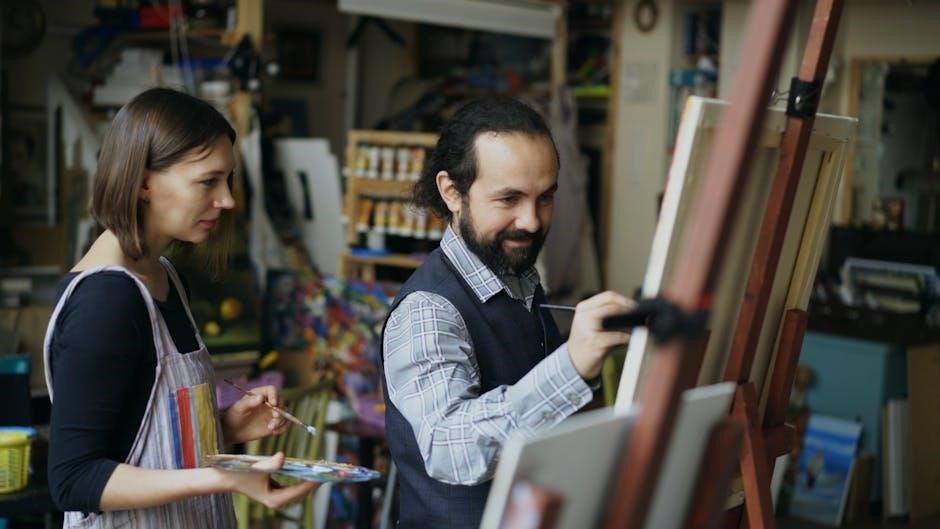
Prompt students to explore layering techniques, building up multiple layers of dots to create depth, luminosity, and complex color interactions.
Facilitate open-ended projects with minimal constraints, allowing students to freely interpret themes and express their unique artistic visions.
Celebrate unconventional outcomes and unexpected discoveries, emphasizing the value of experimentation in the artistic process.
Promote a mindset of playful exploration, where mistakes are viewed as opportunities for learning and creative growth within pointillism.

Assessment and Extension Activities
Evaluate student understanding through artwork analysis, technique application, and discussions on optical mixing; extend learning with digital art projects and explorations of diverse mediums.
Advanced students can delve into complex compositions and nuanced color interactions, pushing the boundaries of pointillism.
Evaluating Student Understanding of Pointillism
Assessing student comprehension of pointillism extends beyond simply observing the completion of a dotted artwork. A multifaceted approach provides a clearer picture of their grasp of the technique and underlying principles.
Begin with a visual analysis of student work, focusing on the density and arrangement of dots. Are they utilizing varied sizes and colors to achieve optical mixing? Is there evidence of intentional color choices based on color theory principles?
Encourage students to articulate their process. Class discussions where they explain their color selections, compositional decisions, and challenges encountered offer valuable insights. Written reflections, asking students to describe the effects of optical mixing and the historical context of pointillism, further solidify understanding.
Consider a short quiz assessing knowledge of key figures like Seurat and Signac, and the core concepts of optical blending. Observe their ability to apply the technique independently, demonstrating mastery of dot application and color interaction. Finally, peer critiques, guided by specific criteria, foster critical thinking and collaborative learning.
Pointillism-Inspired Digital Art Projects
Transitioning the principles of pointillism to digital platforms opens exciting avenues for student creativity and technological integration. Digital art software allows for precise dot placement and effortless color experimentation, expanding possibilities beyond traditional mediums.
Students can utilize tablet apps or computer programs to create digital paintings composed entirely of dots. Encourage exploration of layering modes and brush settings to simulate optical mixing effects. Consider projects where students recreate famous pointillist works digitally, analyzing the original compositions and color palettes.
Introduce the concept of pixel art as a modern extension of pointillism. Students can design pixelated characters or landscapes, understanding how individual pixels function as “dots” of color. Animation projects, using a series of pointillist-inspired frames, can demonstrate movement and storytelling.
Furthermore, explore digital tools that automatically generate pointillist effects from photographs, prompting discussions about algorithmic art and the relationship between technology and artistic expression. These projects reinforce understanding while fostering digital literacy.
Exploring Optical Mixing in Different Mediums
Pointillism’s core principle – optical mixing – extends beautifully beyond paint, offering a rich exploration for students. Encourage experimentation with diverse materials to demonstrate how the eye blends colors placed in close proximity.
Introduce colored pencils, markers, or even small adhesive dots. Students can create images using these mediums, observing how the perceived color shifts based on dot density and arrangement. Explore the effect of layering different colors to achieve nuanced shades.
Consider using unconventional materials like yarn, fabric scraps, or beads to construct pointillist-inspired mosaics. This tactile approach reinforces the concept of building images from individual color elements.
Discuss how the surface texture influences optical mixing; a rough surface might diffuse colors differently than a smooth one. Comparing results across mediums deepens understanding of how perception plays a crucial role in color interpretation, solidifying the pointillist technique.
Advanced Pointillism Techniques for Older Students
For advanced learners, delve into the complexities of pointillism beyond basic dot application. Introduce complementary color interactions and simultaneous contrast to heighten visual vibrancy. Challenge students to create works with a limited palette, relying heavily on optical mixing for a full range of tones.
Explore varying dot sizes and densities to create depth and texture. Encourage students to analyze Seurat and Signac’s techniques, noting how they manipulated dot placement to suggest form and movement.
Introduce the concept of broken color and its relationship to pointillism. Assign projects requiring students to depict light and shadow solely through dot variations, fostering a deeper understanding of color theory.
Facilitate discussions on the scientific principles behind optical mixing, linking art to perception and physiology. Encourage experimentation with unconventional compositions and subject matter, pushing the boundaries of the technique.

Resources for Teachers
Online platforms, books, and museum visits offer invaluable support for teaching pointillism. These resources enhance lesson plans and inspire student creativity.
Explore digital art projects and articles to deepen understanding of this captivating technique and its historical context within art education.
Online Resources for Pointillism Education
Numerous digital platforms provide teachers with readily accessible resources for enriching their pointillism lessons. Websites like the Metropolitan Museum of Art (https://www.metmuseum.org/) offer high-resolution images of Seurat and Signac’s masterpieces, alongside detailed analyses of their techniques and historical context.
Khan Academy (https://www.khanacademy.org/) features art history modules that delve into pointillism, explaining the scientific principles behind optical mixing and color perception. These modules often include interactive exercises and quizzes to assess student understanding.
Pinterest (https://www;pinterest.com/) is a treasure trove of visual inspiration, showcasing diverse pointillism projects suitable for various age groups and skill levels. Teachers can find examples of student artwork, step-by-step tutorials, and innovative approaches to dot application.
YouTube (https://www.youtube.com/) hosts a wealth of instructional videos demonstrating pointillism techniques, from basic dotting exercises to more advanced color blending strategies. These videos can be particularly helpful for visual learners and provide a clear demonstration of the process.
Don’t forget to explore educational blogs and art websites dedicated to teaching art fundamentals, as they often feature articles and lesson plans specifically focused on pointillism.
Books and Articles on Pointillism
For a comprehensive understanding of pointillism, several books offer invaluable insights for educators. “Georges Seurat: The Paintings” by John Rewald provides a detailed examination of Seurat’s oeuvre, analyzing his artistic process and theoretical underpinnings. “Signac and the Independent Exhibitionists” by Penelope Glasser explores the contributions of Paul Signac and the broader Neo-Impressionist movement.
Art history textbooks often dedicate sections to pointillism, contextualizing it within the broader landscape of 19th-century art. Scholarly articles published in art journals, such as “The Art Bulletin” and “Art Journal,” delve into specific aspects of pointillism, offering nuanced interpretations and research findings.
Consider “Pointillism” by Paul Smith, offering a concise yet thorough overview of the technique and its historical significance. For classroom-friendly resources, seek out books specifically designed for art education, providing simplified explanations and project ideas.
Online databases like JSTOR (https://www.jstor.org/) and ProQuest offer access to a vast collection of art-related articles, enabling teachers to stay abreast of current scholarship on pointillism.
Museums and Galleries Featuring Pointillist Art
To enrich your pointillism instruction, virtual or in-person visits to museums housing significant collections are invaluable. The Metropolitan Museum of Art in New York City boasts several masterpieces by Seurat and Signac, offering students direct exposure to their techniques.
The Art Institute of Chicago is renowned for its exceptional collection of Impressionist and Post-Impressionist art, including iconic pointillist paintings like Seurat’s “A Sunday on La Grande Jatte.” The Musée d’Orsay in Paris provides a comprehensive overview of 19th-century French art, showcasing the evolution of pointillism.
Smaller museums and galleries often feature rotating exhibitions that may include pointillist works. Explore online museum collections for virtual tours and high-resolution images, bringing these artworks into the classroom digitally.
Utilize museum websites for educational resources, lesson plans, and artist biographies. Encourage students to research specific paintings and share their observations, fostering critical thinking and appreciation for this unique art form.